
Rabeprazole Sodium Tablets IP Manufacturers in India — A B2B Sourcing & Franchise Guide
Published by Ellanjey Lifesciences | Panchkula, Haryana
Gastroenterology is one of the most reliable commercial segments in the Indian pharma franchise world. Not because it’s trendy — it’s been a consistent prescriber priority for decades. Acid peptic disorders, GERD, peptic ulcers, and H. Pylori-driven gastritis account for a staggering volume of daily OPD consultations across general medicine, gastroenterology, and even surgical follow-up care. Inside that segment, Rabeprazole Sodium has earned its place as the PPI of choice for a large share of Indian gastroenterologists and general physicians — outpacing older molecules like Ranitidine and holding its ground against Pantoprazole and Omeprazole through a combination of faster onset, potency, and clinical familiarity.
If you’re a franchise partner evaluating your next gastro addition, or a brand owner looking for a reliable third-party manufacturer for Rabeprazole Sodium 20mg tablets, the manufacturing landscape in India has both established giants and agile PCD-focused companies worth understanding. This guide breaks down who’s who, what manufacturing actually involves, what timelines look like, and where the money is — geographically and commercially.
What Manufacturing Rabeprazole Sodium Tablets IP Actually Requires
This is where most sourcing conversations go shallow. Rabeprazole isn’t a difficult molecule to manufacture, but it has specific sensitivity requirements that determine whether the finished tablet performs as intended or degrades before it reaches the patient.
Rabeprazole Sodium is highly sensitive to both moisture and light. This means the manufacturing environment — granulation, blending, compression, and coating — needs to maintain controlled humidity and temperature conditions throughout. The enteric coating or gastro-resistant formulation (mandatory for Rabeprazole IP, since the molecule degrades in acidic stomach conditions before absorption) requires a validated coating process with pH-specific dissolution testing.
| Manufacturing Parameter | Requirement |
|---|---|
| Facility Type | WHO-GMP/Schedule M compliant dry tablet manufacturing unit |
| API Grade | Rabeprazole Sodium IP — sourced from CDSCO-approved vendors |
| Granulation | Dry granulation preferred; moisture-controlled environment mandatory |
| Coating | Enteric coating / gastro-resistant coating validated to USP/IP dissolution standards |
| Packaging | Alu-Alu blister preferred for moisture barrier; standard PVC permissible for select markets |
| Storage | Cool, dry, below 25°C; light-protected during production and storage |
| QC Tests | Dissolution testing (enteric release), assay, content uniformity, hardness, friability |
| Stability | ICH Zone IVb (40°C/75% RH) accelerated stability data required |
The enteric coating step is non-negotiable and is often where cheaper manufacturers cut corners — using insufficient coating thickness or skipping dissolution validation. A Rabeprazole tablet that releases in the stomach rather than the intestine doesn’t just underperform — it risks patient harm and prescriber complaint, both of which destroy franchise territory credibility quickly.
Manufacturing to Market — Timeline Reality
Understanding timelines before you commit capital matters. Here’s the realistic production-to-dispatch flow for a standard Rabeprazole 20mg 10×10 order:
| Stage | Typical Duration |
|---|---|
| New brand/product registration (State Drug Authority) | 4 – 8 weeks |
| First batch — private label / third-party manufacturing | 3 – 5 weeks |
| Repeat batch (existing registration) | 10 – 18 working days |
| Quality release and batch documentation | 5 – 7 days post-manufacturing |
| Dispatch to franchise partner (within India) | 2 – 4 days post-release |
| Total first-order cycle (new product) | 8 – 14 weeks end-to-end |
The timelines above assume a well-organised manufacturer. Companies that don’t pre-plan their API procurement, don’t maintain validated coating batch processes, or run batch scheduling on ad hoc calendars will stretch these windows unpredictably — a supply gap during seasonal GERD peaks (summer months and post-festive seasons are the worst times to run short) can undo months of territory investment.
Top 10 Rabeprazole Sodium Tablet Manufacturers — Big Pharma vs. PCD Companies
This distinction matters commercially. Big pharma companies dominate brand recall and hospital formularies but are not your manufacturing partners — they’re your competition in the field. PCD-focused manufacturers are who you’re actually looking for.
Big Pharma Brands (Market Reference — Not PCD Partners):
| Company | Brand Name | Market Positioning |
|---|---|---|
| Sun Pharmaceutical | Razo 20 | Premium branded, pan-India |
| Cipla Ltd. | Rabicip 20 | High recall, hospital-driven |
| Dr. Reddy’s Laboratories | Rabeloc 20 | Branded ethical, specialist push |
| Mankind Pharma | Rablet 20 | Volume mid-market, aggressive MR coverage |
| Torrent Pharmaceuticals | Torrab 20 | Branded ethical, South India strong |
| Alkem Laboratories | Rabonik Plus | Combination segment leader |
| Cadila / Zydus | Rabez 20 | Institutional and retail mix |
These companies serve as MRP benchmarks — their trade pricing tells you where the ceiling is and informs your positioning. They don’t offer PCD franchise or third-party manufacturing for your brand.
PCD & Niche Manufacturers price guide and top 10 rabeprazole sodium tablet brands (Your Actual Sourcing Pool):
| Company | Location | Brand | Box Price (10×10) | Certifications |
|---|---|---|---|---|
| Ellanjey Lifesciences | Panchkula, HR | ELLRAB-20 | ₹45/strip (₹4.5/unit) | WHO-GMP, ISO |
| Salvus Pharma | Mohali, PB | Rabisal 20 | ₹60/strip | WHO-GMP, ISO, GLP |
| Servocare Lifesciences | Panchkula, HR | Razle-20 | On Request | GMP Certified |
| Medlock Healthcare | Panchkula, HR | PPILOC-20 | ₹65/strip | GMP Certified |
| Waylone Healthcare | Ambala, HR | RAYLONE-20 | ₹45/strip | GMP Certified |
| Vridam Healthcare Pvt. Ltd. | Nashik, MH | Vrirab 20 | ₹ 51.56/strip | GMP Certified |
| Betamax Remedies Pvt. Ltd. | Una, HP | Betazole R20 | ₹ 80/strip | GMP Certified |
| Blyners Pharmaceuticals | Nashik, MH | Blyrab 20 | ₹ 90/strip | GMP Certified |
| Saphnix Life Sciences | Mohali, PB | Rabdicure 20 | ₹ 47/strip | WHO-GMP, ISO |
| Lavish Biotech | Panchkula, HR | Lavirabe-20 | ₹ 54/strip | GMP Certified |
Prices sourced from IndiaMart verified listings. Actual franchise/net rates negotiated separately. GST applicable extra.
Price Comparison — Where the Market Actually Sits
The wholesale pricing range for Rabeprazole Sodium 20mg (10×10 box = 100 tablets) is one of the widest in the generic tablet segment:
| Price Point | Supplier Tier | What It Typically Reflects |
|---|---|---|
| ₹30 – ₹55/box | Generic commodity traders | Minimal documentation, no brand infrastructure, institutional tender only |
| ₹55 – ₹100/box | Mid-tier PCD manufacturers | GMP certified, basic documentation, entry franchise pricing |
| ₹100 – ₹550/box | Quality PCD + branded PCD | WHO-GMP, full documentation, Alu-Alu option, prescriber-ready branding |
| ₹550 – ₹900+/box | Premium / export-grade | Full regulatory dossier, export compliance, large batch economics |
For a franchise partner building a gastro brand in the ethical prescription channel, the ₹100–350 range per 10×10 box delivers the right combination of quality compliance, documentation standard, and MRP headroom for healthy trade margins in the ₹85–120 per strip retail range.
Location-Wise Profit Opportunity for Rabeprazole Franchise
Geography significantly impacts return on franchise investment for this molecule. Here’s how the opportunity maps across India:
| Territory Zone | Market Opportunity | Competition Level | Recommended Priority |
|---|---|---|---|
| North India (Punjab, Haryana, HP, Delhi-NCR, UP) | Very high — dense GP and gastro prescriber base, high GI disorder incidence | Moderate–High | Tier 1 priority |
| East India (West Bengal, Bihar, Odisha, Jharkhand) | High — underserved by organised PCD, large rural prescriber base | Low–Moderate | High ROI opportunity |
| South India (Tamil Nadu, Karnataka, Kerala, AP) | High urban GERD load, specialist-driven prescriptions | High in metros | Metro specialist + Tier 2 city strategy |
| West India (Maharashtra, Gujarat, Rajasthan) | High volume market, price-competitive | High | Niche therapy combination approach |
| Northeast India | Low organised PCD penetration, consistent acid reflux incidence | Very Low | First-mover advantage |
| Central India (MP, Chhattisgarh) | Medium demand, growing Tier 2 cities | Low | Steady, lower competition entry |
For Ellanjey Lifesciences‘ franchise partners in North India specifically, our Panchkula manufacturing location gives you a supply chain advantage — dispatch within 2–3 working days to Punjab, HP, Haryana, Delhi-NCR, and western UP, with no transit degradation risk in temperature-controlled packaging.
Why PCD Companies Beat Big Pharma for Your Franchise Business — Budget and Quality
The MNC pharma rep in your territory covers the largest hospitals and the busiest specialist OPDs. They don’t go to the 30-patient GP clinic in a Tier 2 town. That gap is your market.
Choosing a PCD manufacturer like Ellanjey Lifesciences over trying to distribute a big-brand Rabeprazole gives you three advantages that compound over time. First, monopoly territory rights — no internal competition, no channel conflict, your investment stays protected. Second, brand ownership — every prescription your field work converts goes to your brand’s recall, not Sun Pharma’s. Third, genuine margin architecture — PCD franchise pricing from a quality manufacturer gives you 35–55% margins that a sub-distributor arrangement on an MNC brand never approaches.
On quality: the question isn’t whether WHO-GMP PCD manufacturers can match big pharma output quality. The question is whether you verify the right parameters before choosing. Enteric coating validation, API source documentation, dissolution testing reports, and batch COAs — if your PCD manufacturer provides these without being asked, you’ve found a serious partner.
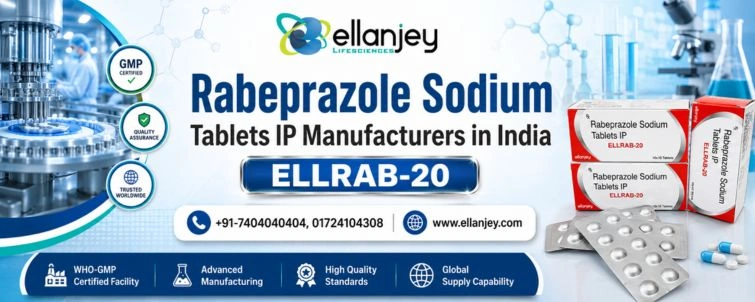
Ellanjey Lifesciences’ ELLRAB-20 carries WHO-GMP manufacturing, Alu-Alu packaging option, 24-month validated shelf life, and a full promotional support kit for franchise partners — visual aids, product literature, and dedicated account support from our Panchkula operations team.
FAQs
What is the difference between Rabeprazole Sodium IP and Rabeprazole Sodium EC tablets?
IP (Indian Pharmacopoeia) refers to the quality standard the API meets. EC (enteric coated) refers to the tablet’s coating technology that prevents dissolution in the stomach and ensures release in the intestine. ELLRAB-20 meets both — IP-grade API with gastro-resistant enteric coating.
Why is Alu-Alu packaging important for Rabeprazole tablets?
Rabeprazole Sodium is moisture and light sensitive. Standard PVC blisters allow some moisture permeation over time, which can degrade the enteric coating and reduce potency before expiry. Alu-Alu provides a complete moisture and light barrier — critical for markets in humid or coastal zones and for longer-shelf-life institutional supply.
Can Rabeprazole 20mg be combined with other molecules in a single tablet for PCD?
Yes — Rabeprazole + Domperidone and Rabeprazole + Levosulpiride are two widely prescribed combinations in India. Ellanjey Lifesciences manufactures combination gastro preparations; ask our team about the ELLRAB combination range for franchise partners who want to build a complete gastro portfolio.
What is the typical prescriber target for a Rabeprazole franchise partner?
General physicians are your primary volume driver — most GI prescriptions originate at the GP level. Gastroenterologists are the specialist credibility anchor. A well-structured territory strategy covers 20–30 GPs for volume and 5–10 gastro specialists for brand positioning. Surgical specialists (post-op ulcer prophylaxis) are a secondary but consistent prescriber source.
How do I verify a PCD manufacturer’s enteric coating quality before ordering?
Ask for the in-vitro dissolution test report for the specific batch. The dissolution profile should show less than 10% drug release in simulated gastric fluid (pH 1.2) after 2 hours, and more than 80% release in simulated intestinal fluid (pH 6.8) within 60 minutes. Any reputable WHO-GMP manufacturer will have this data — it’s a compulsory QC parameter for gastro-resistant tablets.



 Call us
  Contact Us